
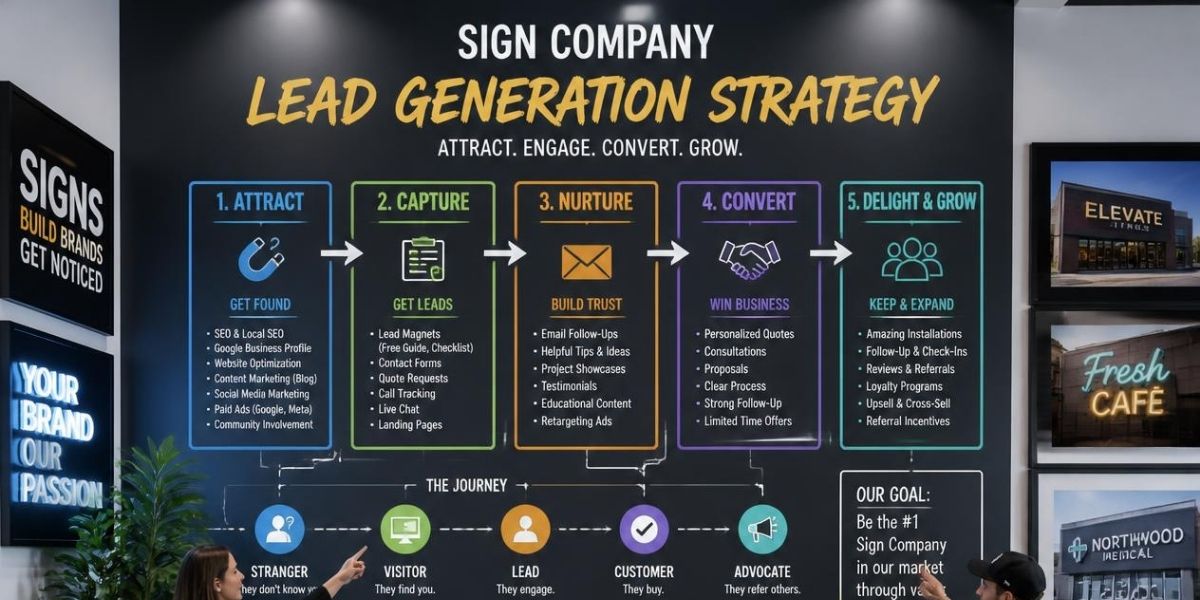
You own sign company and looking for secret working method to generate leads for sign company. You got right page. Today in this article, I am going to tell you step by step process to generate hundreds of high convertible Sign Company leads.
I learnt this all marketing ideas by self after working with Sign Company for several years. I was hired to do SEO for sign shop where i have tested and find these unique method to generate hundreds of commercial sign leads.
Before I start i would like you to prepare list of information mentioned below:
- Write down list of your service. For Example – Tampa, FL
- Write down list of services you provide. For Example – Channel letters, Pylon Signs, LED Signs, Custom Signs
- Business Name
- Business Address
- Phone Number
- Business Email
Know what your customer is searching for
Not for only sign shop, but for every business owner you must have clear idea of what your customer use to search for. In case of sign company, customer use to search like Pylon Signs Tampa, Commercial Sign Company Near me, Business Signs Portland, ME, Channel letters Maker in Miami, Fl, Custom Signs Clearwater, Maine Custom Signs.
Now you have clear idea of what your customer is searching on google, bing, yahoo and other search engine platform. But because of generating AI. People also started searching on AI platform like Chatgpt, Claude, Gemini, and others.
User behaviour is completely diffrent in case of AI searches. They are searching like Suggest me best sign company near me, best sign company in Portland, ME.
AI is getting smarter. It is now capable of reading your pages of website, reviews, your workflow and then recommend to user if it trusts your business.
We will cover later how does AI rank your business specially sign company. What are their criteria.
Top 10 Organic Sign Company Marketing Ideas for Regular Leads Flow
All these sign marketing method is tried and tested by me.
1. Must Have an Attractive, Fast-Loading, and Easy-Workflow Website
Your website is your digital storefront, and for a sign company it’s often the first real “sample” of your work a potential customer sees. If it’s slow, cluttered, or confusing, you lose the lead before they even see your portfolio.
Why it matters:
- A slow website (loading over 3 seconds) causes a large percentage of visitors to leave before the page even loads
- Google uses page speed and mobile experience as ranking factors, so a slow site also hurts your SEO
- A confusing website means visitors can’t find your services, pricing hints, or contact form — and they simply leave
What a strong sign company website needs:
- Clean, modern design with high-quality photos/videos of real installations (not stock photos)
- Fast hosting and optimized images (compressed, next-gen formats like WebP)
- Simple navigation: Home → Services → Portfolio → About → Contact/Quote
- A clear, easy “Get a Free Quote” button visible on every page
- Mobile-first design, since most local searches happen on phones
- Click-to-call buttons and an embedded contact form that doesn’t require too many fields
- Individual service pages for each sign type (channel letters, LED signs, vehicle wraps, monument signs, banners) so each can rank separately in search
- Fast, simple workflow: visitor → sees portfolio → requests quote → gets a fast response, with as few clicks as possible in between
2. Correct NAP Information (Name, Address, Phone)
NAP consistency is one of the most overlooked but critical local SEO factors. NAP stands for your business Name, Address, and Phone number, and it must be 100% identical across your website, Google Business Profile, and every directory listing (JustDial, Sulekha, IndiaMART, Facebook, Yelp, industry directories, etc.).
Why it matters:
- Search engines cross-check your NAP across the web to confirm your business is legitimate and to determine your local ranking
- Even small inconsistencies (like “St.” vs “Street,” or an old phone number on one directory) confuse search engines and can hurt your local rankings
- Inconsistent NAP also confuses customers who might call an outdated number
Action steps:
- Audit every directory and citation where your business is listed
- Standardize the exact format of your name, address, and phone number
- Update old listings and remove duplicate/incorrect ones
- Keep a master document of your official NAP so every new listing matches it exactly
3. Must Be Active on Social Media to Give Social Signals — Especially Instagram, Pinterest, and Reddit
Search engines increasingly factor in “social signals” — engagement, shares, and consistent activity — as trust indicators. For a visual business like sign-making, social media is also a direct lead-generation channel, not just a branding tool.
Instagram:
- Post before/after installation photos, reels of the installation process, and client testimonials
- Use local and industry hashtags (#customsignage, #[cityname]signs)
- Tag the business location for every post to strengthen local relevance
Pinterest:
- Sign design inspiration boards perform extremely well on Pinterest, since users actively search for “storefront sign ideas,” “office signage ideas,” etc.
- Pinterest pins have a long shelf life and can drive traffic to your website for months or years after posting
Reddit:
- Participate genuinely in relevant subreddits (small business, local city subreddits, entrepreneurship, signage/design communities)
- Answer questions helpfully instead of directly promoting — this builds authority and occasionally drives organic mentions and backlinks
General consistency tips:
- Post regularly rather than in bursts — consistency signals an active, trustworthy business
- Engage with comments and messages quickly, since response time affects both algorithm reach and lead conversion
4. Collect Real Reviews — Not Fake Ones
Reviews are one of the strongest local ranking factors and the single biggest trust signal for a new customer deciding between sign companies.
Why real reviews matter:
- Google’s algorithms are increasingly good at detecting fake or purchased reviews, and getting caught can lead to your listing being suspended or penalized
- Fake reviews often read generic or overly polished, which savvy customers can spot too, damaging trust
- Real reviews, even a mix of 4 and 5 stars with genuine detail, build far more credibility than a suspiciously perfect record
How to collect real reviews consistently:
- Ask for a review right after project completion, when customer satisfaction is highest
- Send a direct Google review link via SMS or email to make it a one-click action
- Train installation teams to politely request a review on-site once the job is done
- Respond to every review, positive or negative, professionally — this itself is a trust and engagement signal
- Never offer payment or discounts explicitly in exchange for a review, as this violates Google’s policies
5. Optimize Your Google Business Profile (GBP) for Local Ranking
Your Google Business Profile is often the very first thing a potential customer sees — before your website. It shows up in Google Maps and the local 3-pack, which is prime real estate for local searches like “sign company near me.”
Optimization checklist:
- Choose the correct primary category (e.g., “Sign Shop”) and add relevant secondary categories
- Fill out every available field: services, business description, hours, service area
- Add high-quality photos of completed projects, your team, and your storefront/workshop
- Use keywords naturally in your business description (e.g., “custom LED signs, channel letters, and vehicle wraps in [city]”)
- Add your website link, booking/quote link, and accurate phone number
- Enable messaging so leads can contact you directly through the GBP listing
- Add products/services with descriptions and, where possible, pricing ranges
6. Post on Your GMB Profile at Least Twice a Week to Keep It Fresh
Google Business Profile isn’t a “set it and forget it” listing — it rewards activity. Regular posts signal to Google (and to customers browsing your listing) that your business is active and currently operating.
What to post:
- Recently completed project photos with a short description
- Special offers or seasonal promotions
- Behind-the-scenes content (design process, installation day)
- Company updates, new services, or new equipment
- Customer testimonials or highlights from reviews
Why twice a week works well:
- It’s frequent enough to keep the profile looking active without becoming a heavy daily burden
- Consistent posting has been linked to better visibility in the local map pack
- Fresh content gives potential customers more reasons to trust and choose you over a competitor with a stale, outdated listing
7. Be Active in Social Media Groups
Beyond your own profiles, participating in relevant local and industry Facebook/LinkedIn groups is a powerful, often underused lead source.
Where to be active:
- Local business owner groups and community Facebook groups
- Local Chamber of Commerce or business networking groups online
- Industry-specific groups for retail, hospitality, real estate, and construction professionals
- LinkedIn groups for commercial contractors, architects, and property managers
How to engage effectively:
- Answer questions genuinely when someone asks about signage, even if it’s not a direct sales pitch
- Share useful content (tips on choosing signage, regulations, maintenance) rather than only promotional posts
- Build relationships with other local business owners — many of them will need signage themselves or know someone who does
- Be consistent and patient; group-based trust-building generates leads over months, not days
8. Add Correct Schema to Your Website with Keywords
Schema markup (structured data) helps search engines understand exactly what your website content means, which improves your chances of appearing with rich results (star ratings, FAQs, business info) directly in search results.
Key schema types for a sign company:
- LocalBusiness / Store schema — includes your NAP, hours, service area, and category
- Service schema — for each individual service page (LED signs, vehicle wraps, etc.)
- Review/AggregateRating schema — to potentially display star ratings in search results
- FAQ schema — for FAQ sections, which can appear as expandable results in Google
- BreadcrumbList schema — helps search engines and users understand your site structure
Best practices:
- Use keyword-relevant service names and descriptions within the schema, matching what customers actually search for
- Keep schema data accurate and up to date — mismatched schema (e.g., wrong hours) can hurt trust with search engines
- Test your schema using Google’s Rich Results Test tool before publishing
9. Have the Right Website Content Marketing Strategy
Content marketing builds long-term organic traffic and positions your company as the local authority on signage — which pays off in both SEO rankings and customer trust.
Content pillars to build:
- Educational blog posts: “How to Choose the Right Sign for Your Storefront,” “LED vs. Non-Illuminated Signs: Which Is Right for You?”
- Local content: “Signage Regulations in [City] You Need to Know,” “Best Sign Styles for [City]’s Retail District”
- Cost guides: “How Much Does Custom Signage Cost in 2026?” — these attract high-intent searchers doing research before buying
- Case studies: Detailed breakdowns of specific projects — the challenge, the solution, and the result, with photos
- Comparison content: “Vinyl Banners vs. Rigid Signs: Pros and Cons”
Distribution strategy:
- Publish consistently (even one strong post every 2 weeks beats sporadic bursts)
- Repurpose each blog post into social media captions, short videos, and email newsletter content
- Internally link blog content to relevant service pages to guide readers toward a quote request
- Update older content periodically to keep it accurate and relevant for SEO
10. Short Video Marketing
Short-form video is currently one of the highest-engagement content formats across Instagram Reels, YouTube Shorts, and even Pinterest and Facebook — and it’s a natural fit for a visually driven business like signage.
Video ideas that work well:
- Time-lapse videos of full sign installations, from design to final mounting
- “Before and after” reveal videos of storefront transformations
- Quick tips: “3 signs your business signage needs an upgrade”
- Behind-the-scenes footage from the design and fabrication workshop
- Customer testimonial clips, kept short and authentic
- Team introductions to humanize the brand
Why it works:
- Short videos are heavily favored by social media algorithms right now, giving more organic reach than static posts
- They showcase craftsmanship and quality in a way photos alone can’t
- They’re highly shareable, which extends your reach beyond your existing followers
- Video content can also be embedded on your website and service pages to boost engagement and time-on-page, both of which support SEO
Offline Marketing for Sign Companies: Traditional Ideas That Still Generate Real Leads
1. Vehicle Wraps — Your Own Moving Billboard
Wrapping your company vehicles (vans, trucks, installation trailers) in a bold, professional design is one of the highest-ROI offline marketing tactics available, because it’s a one-time cost that keeps advertising every single day the vehicle is on the road.
- Design should include your logo, tagline, phone number, and website — kept simple enough to read at a glance from a moving car
- Since the vehicle is literally driving to and from signage jobs, it directly demonstrates your craftsmanship to everyone who sees it
- Park the vehicle strategically near job sites or busy intersections when not in use for extra visibility
2. Job-Site Yard Signs
After completing a project, place a small branded sign or plaque at the job site (with the client’s permission) that says something like “Signage by [Your Company Name]” along with your phone number.
- This works especially well on storefronts, construction sites, and new business openings, where foot and vehicle traffic naturally passes by
- It turns every finished project into a passive lead generator for weeks or months afterward
- It’s essentially free advertising, since the sign is often left up by the client as part of the finished look
3. Direct Mail and Door Hangers
Sending physical mail or door hangers to a targeted list of local businesses is a classic tactic that still works well for B2B services like signage.
- Target newly registered businesses, newly leased commercial properties, or businesses with outdated/damaged signage
- Include a clear offer (e.g., “Free design mockup” or “10% off your first sign”) and a simple way to respond — a phone number, QR code, or website
- Postcards with strong before/after photos tend to perform better than plain text mailers
4. Print Advertising
Placing ads in local newspapers, business journals, real estate magazines, or trade publications can still reach decision-makers who aren’t primarily online.
- Local business or chamber of commerce newsletters are especially effective, since readers are already business owners
- Real estate and commercial property magazines can reach landlords and developers who regularly need signage for new tenants
- Keep the ad visual-heavy, since signage is a product people need to see, not just read about
5. Trade Shows and Exhibitions
Setting up a booth at signage, construction, retail, or franchise trade shows puts you directly in front of an audience that’s already interested in your industry.
- Bring physical samples or a live demo (like a lit-up LED sign) to stand out from booths with just brochures
- Trade shows are also a great place to meet potential referral partners — contractors, architects, and franchise developers all attend these events
- Collect contact details on the spot with a simple sign-up sheet or QR code for a free quote
6. Local Networking Groups
Joining and actively participating in local business networking groups builds long-term referral relationships that consistently generate leads over time.
- Chamber of Commerce: A strong way to meet local business owners who may need signage and to build community credibility
- BNI (Business Network International): Structured referral groups where members actively pass business to each other
- Rotary Club and similar community organizations: Build local reputation and relationships that often lead to word-of-mouth referrals
7. Cold Calling and In-Person Cold Outreach
Directly reaching out to businesses that are newly opened, expanding, or have outdated signage is a proactive way to generate leads rather than waiting for inbound interest.
- Build a target list from new business registrations, newly leased commercial spaces, or visibly worn/damaged signage you notice while driving around
- Lead with value — offering a free design consultation or mockup works better than a generic sales pitch
- In-person visits or drop-ins with a printed portfolio can leave a stronger impression than a cold call alone
8. Sponsorships and Community Involvement
Sponsoring local events, sports teams, or community fundraisers builds brand visibility and goodwill in your service area.
- Sponsoring a local sports team often comes with your logo on jerseys or a sign at the field — a natural, on-brand form of advertising
- Sponsoring local fairs, festivals, or charity events keeps your name visible to a broad local audience
- This tactic works best as a long-term brand-building play rather than a direct lead-generation tool
9. Referral Cards and Business Cards
A simple but often overlooked tool — well-designed referral or business cards that installation crews and staff hand out during and after every job.
- Include a referral incentive on the card itself (e.g., “Refer a friend and both get a discount”)
- Leave a small stack with satisfied clients so they can pass them along to other business owners
- Design the card with the same visual quality as your signage work, since it’s a direct reflection of your craftsmanship
10. Physical Portfolio Book / Sample Kit
Having a printed portfolio book or physical material samples to bring to in-person meetings, trade shows, or cold visits gives potential clients something tangible to evaluate.
- Especially useful for B2B meetings with contractors, architects, and property managers who prefer a physical presentation over a website link
- Include high-quality photos organized by industry (retail, restaurant, office, healthcare) so prospects can quickly find relevant examples
- Physical material samples (vinyl, acrylic, LED modules) help clients understand quality in a way photos alone can’t
11. Local Radio Advertising
In some markets, local radio ads can still reach a broad local business audience, especially during commute hours when business owners are driving.
- Keep the message simple and memorable — a clear call to action with your phone number repeated at least twice
- Works best combined with a special, time-limited offer to create urgency
Buy Sign Pre-qualified Leads
1. Buy Leads from Marketing for Signs (Industry-Specific Lead Generation Services)
Instead of generating every lead from scratch through your own SEO and ads, sign companies can purchase pre-qualified leads directly from lead generation services that specialize in the signage industry, such as Marketing For Signs. These services run their own marketing campaigns to attract people actively looking for signage work, then sell or route those leads to sign companies in the relevant service area.
Why buying leads can work well for a sign company:
- Speed: You start receiving leads almost immediately, without waiting months for SEO or content marketing to build momentum
- Pre-qualification: Leads are often already filtered to include real project details (sign type, budget range, timeline), saving your sales team time
- Industry expertise: A service focused specifically on signage understands what makes a sign lead valuable, unlike generic lead-gen platforms
- Scalability: You can increase or decrease lead volume based on your current capacity, which is useful during slow seasons or when scaling up quickly
Important considerations before buying leads:
- Exclusivity matters: Ask whether leads are sold exclusively to your company or shared with multiple competitors in the same area — shared leads convert at a much lower rate
- Lead quality vs. quantity: A smaller number of well-qualified leads is usually more valuable than a large volume of generic inquiries
- Cost per lead vs. close rate: Track how many purchased leads actually convert into paying jobs, not just how many leads you receive, to calculate true ROI
- Response time: Purchased leads often go cold fast if multiple companies are competing for them, so a quick follow-up process is essential
- Geographic and service match: Confirm the lead source targets your actual service area and the specific sign types you offer (e.g., not just generic “signage” leads but LED, channel letters, wraps, etc., matching your specialty)
Best practices for using bought leads effectively:
- Respond within minutes, not hours — speed is often the deciding factor when a lead has been sent to multiple companies
- Use a CRM to track lead source performance separately from organic and paid leads, so you know if the investment is actually profitable
- Treat bought leads as a supplement to your organic and paid efforts, not a replacement — relying on a single outside source is risky if pricing or lead quality changes
2. Try Programmatic SEO
Programmatic SEO is the practice of using a data template and a structured set of variables (like city names, sign types, or industries) to automatically generate large numbers of unique, targeted landing pages — instead of manually writing one page at a time. For a sign company, this means you can build a genuinely large, keyword-rich footprint across every city, neighborhood, and sign type you serve, at a scale that manual content creation could never match.
How it works:
- You define a page template with variable placeholders (e.g., “[Sign Type] Installation in [City]”)
- You build a dataset of variables to fill it — every service area you cover, every sign type you offer, every industry you serve
- The template combines with the dataset to automatically generate a unique page for each combination, each targeting a specific, low-competition search query
- Example combinations: “Channel Letter Signs in [City],” “LED Signage for Restaurants in [City],” “Monument Signs for Medical Offices in [City]”
Why programmatic SEO can benefit a sign company:
- Massive long-tail coverage: Instead of one generic “Signage Services” page, you can rank for hundreds of specific searches like “vehicle wrap company in [suburb]” or “illuminated signs for gas stations in [city]”
- Captures very specific buyer intent: Someone searching “monument sign for dental office [city]” is far more likely to convert than someone searching “signs,” and programmatic SEO lets you target that exact phrase
- Scales without linear effort: Once the template and dataset are built, adding a new city or sign type is far faster than writing a fully custom page from scratch
- Compounding organic traffic: Unlike paid ads, these pages keep generating free traffic indefinitely once they’re indexed and ranking
Practical use cases for a sign company:
- Location-based pages: “[Sign Type] in [City/Neighborhood]” for every area you service
- Industry-based pages: “Signage for [Industry]” — restaurants, retail stores, medical offices, gyms, auto shops — paired with each city you serve
- Sign-type pages: dedicated pages for channel letters, LED signs, monument signs, vehicle wraps, ADA signage, each customized per location
- Combination pages: “[Sign Type] for [Industry] in [City]” for very specific, low-competition long-tail searches
Important considerations before starting programmatic SEO:
- Avoid thin, duplicate content: Pages must have genuinely unique, useful content for each variation (real local details, relevant photos, specific pricing notes) — simply swapping a city name into an identical template can be flagged as low-quality or duplicate content by search engines
- Prioritize quality over sheer volume: Start with your highest-value combinations (busiest service areas, most-requested sign types) rather than generating hundreds of low-value pages at once
- Internal linking matters: Link these pages to each other and to your main service pages so search engines and users can navigate between them logically
- Pair with real content: Add genuine local proof — photos of actual installations in that city, testimonials from clients in that area — so pages don’t feel automated to visitors
- Monitor performance and prune: Track which pages actually earn traffic and rankings over time, and improve or remove pages that aren’t performing
Conclusion
Generating consistent leads for a sign company isn’t about picking one tactic and hoping it works — it’s about layering multiple channels that reinforce each other over time. A fast, well-built website with correct NAP and schema forms the foundation. Consistent GMB posting, real reviews, and active social media presence on Instagram, Pinterest, and Reddit build the local trust and visibility that both search engines and AI platforms now factor into their recommendations. Offline efforts — vehicle wraps, job-site signage, networking groups, and direct outreach — keep your brand visible in the physical world your customers actually move through every day. And when you’re ready to scale faster, buying pre-qualified leads and building out a programmatic SEO strategy give you two very different speeds of growth: one immediate, one compounding.
The sign companies that win consistently aren’t necessarily doing anything exotic — they’re doing the fundamentals well, staying consistent month after month, and treating every completed project as proof of their own marketing. Start with the organic and local basics if you haven’t already, layer in offline visibility, and add paid leads or programmatic SEO once your foundation can actually convert the traffic you send to it.
